
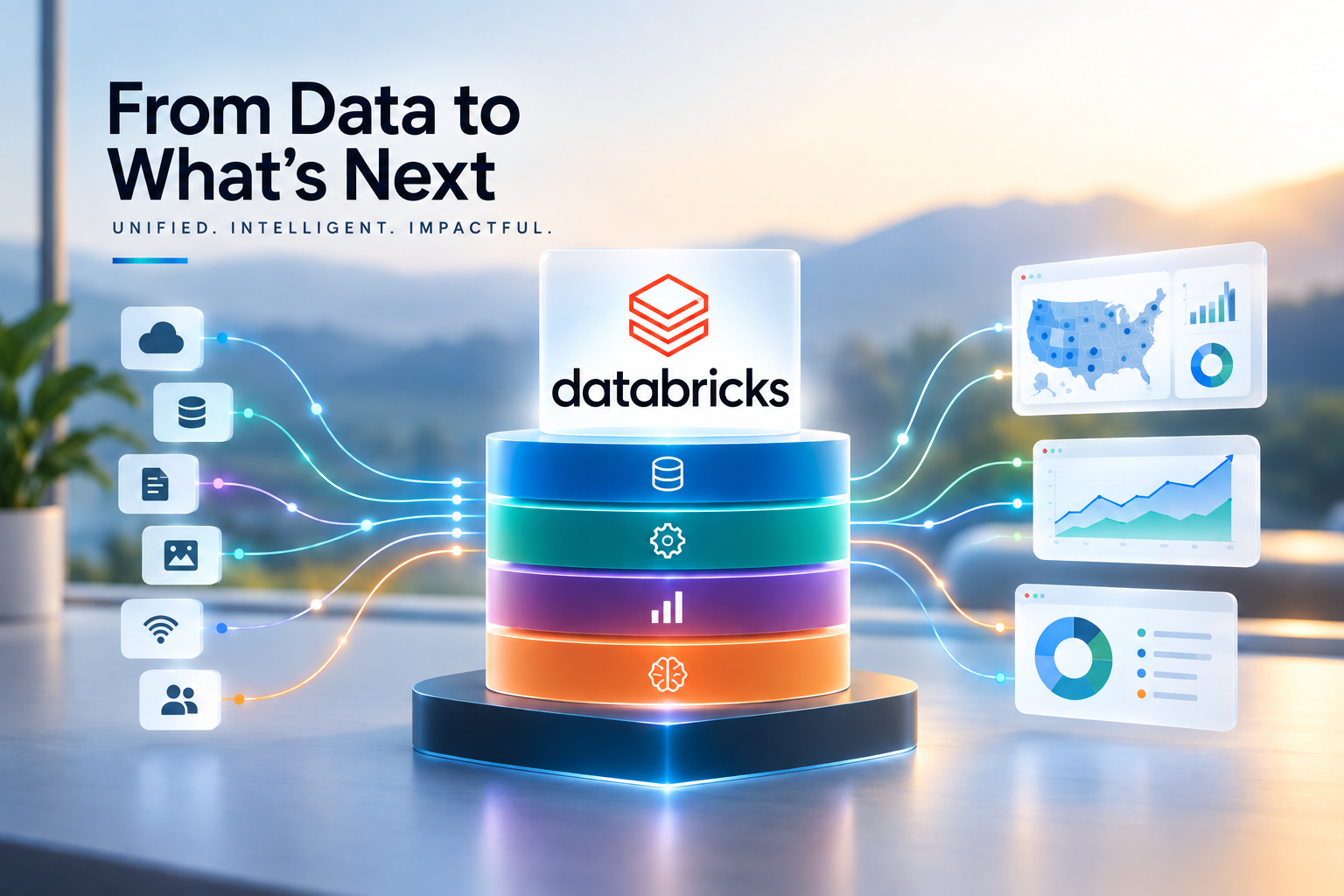
Databricks is a unified cloud platform that brings data warehousing, data engineering, analytics, and machine learning into one environment. It is the usual choice when large-scale transformation work and the analytics built on it need to live together rather than in separate systems.
Databricks Data Intelligence Platform Overview
Databricks is a unified data and AI platform designed to help organizations manage, process, analyze, and derive value from large volumes of data.
The platform brings together capabilities traditionally spread across separate systems, including data engineering, data warehousing, analytics, machine learning, artificial intelligence, and governance. This allows organizations to create a more connected environment for moving data from its raw form into information people and applications can actually use.
For AspirationalX, Databricks is particularly valuable when organizations are working with large, complex, or rapidly growing datasets that require more than traditional databases or reporting tools can efficiently provide.
We use Databricks and Apache Spark to build scalable data pipelines, transform massive datasets, improve processing performance, develop analytic systems, and prepare organizational data for advanced analytics and AI.
The goal is not simply to centralize more data. It is to create an environment where data becomes organized, governed, scalable, understandable, and genuinely useful to the organization.
Typical Use Cases for Databricks
- Large-scale data processing — Process and transform datasets that have outgrown traditional databases, spreadsheets, or single-server applications.
- Data engineering and ETL — Build reliable pipelines that ingest, clean, transform, enrich, and prepare information from multiple sources.
- Data lake and lakehouse architecture — Create centralized environments where structured and unstructured information can be stored, processed, governed, and analyzed.
- Analytics and business intelligence — Prepare trusted datasets for dashboards, reporting, visualization, and organizational decision-making.
- AI and machine learning — Build the data foundation required to train, deploy, and operate machine-learning and AI applications.
- Natural-language data exploration — Enable business users to ask questions of organizational data without requiring advanced SQL or data engineering knowledge for every request.
- Geospatial and behavioral analytics — Process large location, movement, behavioral, or event datasets to uncover patterns and relationships.
- Performance optimization — Improve slow, expensive, or inefficient data workloads through distributed processing and better architecture.
- Data platform modernization — Replace fragmented or legacy data processes with scalable cloud-based data engineering and analytics environments.
- Data governance and access — Establish clearer controls around how organizational data is organized, discovered, accessed, and used.
- Self-service analytics — Give teams greater ability to explore trusted data and answer routine questions without depending on technical specialists for every report.
- Productionizing prototypes — Transform experimental analytics or desktop-based data processes into reliable, scalable production systems.
Our Expertise with Databricks
AspirationalX brings experience with Databricks, Apache Spark, distributed data processing, cloud infrastructure, data engineering, analytics, and large-scale application development.
Our work has included environments where datasets range from millions of individual records to hundreds of terabytes, requiring systems designed specifically for distributed processing and large-scale analytics.
We have used Databricks and Spark to transform complex datasets, develop production ETL pipelines, perform large-scale geospatial analysis, build risk models, and move data processes from prototypes into scalable production environments.
That experience also extends beyond Databricks itself. We understand the surrounding architecture required to make a data platform successful, including AWS, Google Cloud Platform, cloud storage, data lakes, APIs, orchestration, databases, analytics applications, visualization, monitoring, and infrastructure. Databricks rarely operates in isolation.
A successful implementation requires understanding where information originates, how it should be transformed, who needs access to it, how frequently it changes, what questions it needs to answer, what it costs to process, and how downstream applications and people will ultimately use it.
As AI becomes increasingly integrated into modern data platforms, we also help organizations think beyond simply enabling new features. The quality of AI-driven analytics depends heavily on the quality, organization, context, governance, and accessibility of the underlying data.
Our focus is therefore on building a strong data foundation first. Then we usi analytics, machine learning, and AI to make that information increasingly useful and accessible.