
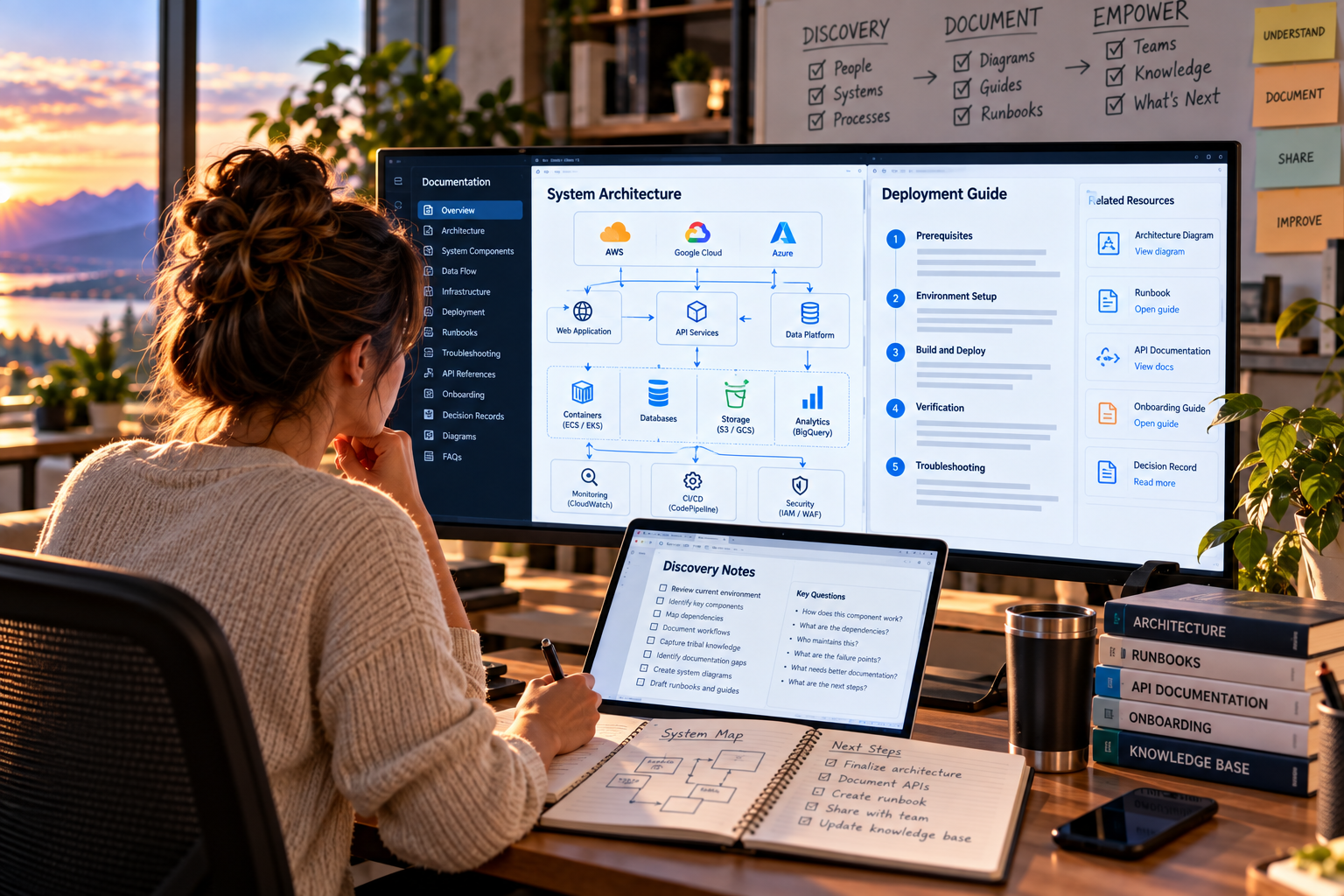
Technical Documentation & Discovery Overview
Complex systems become difficult to maintain, improve, troubleshoot, or transfer when critical knowledge lives only in people’s heads. Technical Documentation & Discovery creates a clearer understanding of how systems and processes actually work and captures that knowledge in a form others can find, understand, and use.
AspirationalX often begins with discovery. We review existing systems, code, infrastructure, applications, processes, documentation, and other available information while working with the people who understand different parts of the environment. This allows us to piece together how technology and processes interact, where dependencies exist, how information moves, why certain decisions were made, and where important knowledge may be missing.
Discovery is particularly valuable in environments that have evolved over time. Systems may have changed hands, documentation may no longer reflect reality, processes may have developed informally, or important decisions may never have been documented at all. Before changing or modernizing those environments, it is important to understand what actually exists.
From there, we create documentation designed around the people who will use it. That can include architecture diagrams, system documentation, technical specifications, process and workflow documentation, runbooks, onboarding materials, implementation guides, troubleshooting procedures, decision records, and organized knowledge bases.
The goal is not documentation for documentation’s sake. It is to make important knowledge easier to find, understand, share, and maintain so teams can operate confidently and critical systems are not dependent on a single person knowing how everything works.
Typical Use Cases for Technical Documentation & Discovery
- Existing system discovery — Investigate applications, infrastructure, integrations, data flows, and processes to develop a clearer understanding of how an existing environment actually operates.
- Architecture documentation — Document the components, relationships, integrations, dependencies, and infrastructure that make up a technical system.
- Knowledge capture — Transfer important information out of individual people’s heads and into documentation that can be shared and maintained by the organization.
- Knowledge base development — Create organized, searchable repositories where teams can find technical, operational, and organizational information.
- Process and workflow documentation — Capture how work moves through an organization, including responsibilities, dependencies, decisions, handoffs, and exceptions.
- Technical specifications — Document requirements, configurations, interfaces, behaviors, and implementation details needed to build or maintain systems.
- Runbooks and operational procedures — Create step-by-step guidance for recurring operations, deployments, maintenance, incidents, and other important technical activities.
- Onboarding and training — Give new team members the context and instructions they need to understand systems and become productive more quickly.
- Troubleshooting documentation — Capture known issues, diagnostic steps, common failure conditions, and resolution procedures so problems can be addressed more consistently.
- Architecture and decision records — Preserve important technical decisions along with the reasoning, tradeoffs, and context behind them.
- Modernization and migration discovery — Understand an existing environment before replacing, migrating, integrating, or redesigning critical systems.
- Team and vendor transitions — Preserve institutional knowledge when responsibilities move between employees, contractors, vendors, or internal teams.
- Documentation assessment — Identify outdated, incomplete, duplicated, fragmented, or missing documentation and establish a clearer structure for maintaining it.
- Ongoing documentation practices — Establish processes and expectations that allow documentation to evolve alongside the systems and teams it supports.
Our Expertise with Technical Documentation & Discovery
AspirationalX brings technical documentation together with hands-on experience in software engineering, cloud infrastructure, data engineering, architecture, operations, project management, and organizational knowledge management.
That technical background matters during discovery. We are not simply recording what people tell us. We can examine systems, infrastructure, code, configurations, data pipelines, applications, workflows, and existing documentation to understand how the individual pieces connect and identify questions or gaps that may require further investigation.
Our work has included environments where technical knowledge was distributed across teams, systems, repositories, tickets, conversations, and individual experience. We help bring those pieces together into a more organized representation of the environment and establish structures that make the information easier to navigate.
We have experience developing and organizing documentation in platforms such as Confluence and other collaborative knowledge systems, including architecture documentation, technical processes, naming conventions, data transformations, system interactions, operational procedures, and project knowledge.
We also understand that different audiences need different levels of detail. An engineer troubleshooting a production system needs different information than a new employee learning the environment, an executive trying to understand dependencies and risk, or a vendor preparing to work within an existing system. Effective documentation should make the right information accessible without requiring everyone to understand every technical detail.
Discovery can also expose more than documentation gaps. It can reveal outdated processes, unclear ownership, unnecessary dependencies, operational risk, duplicated work, or systems that have evolved beyond their original design. Capturing those findings creates a stronger foundation for future modernization, planning, and improvement.
Our focus is therefore not simply on producing documents. It is on building organizational knowledge that survives transitions, supports better decisions, reduces dependency on individuals, and gives teams a clearer foundation for maintaining and improving the systems they rely on.