
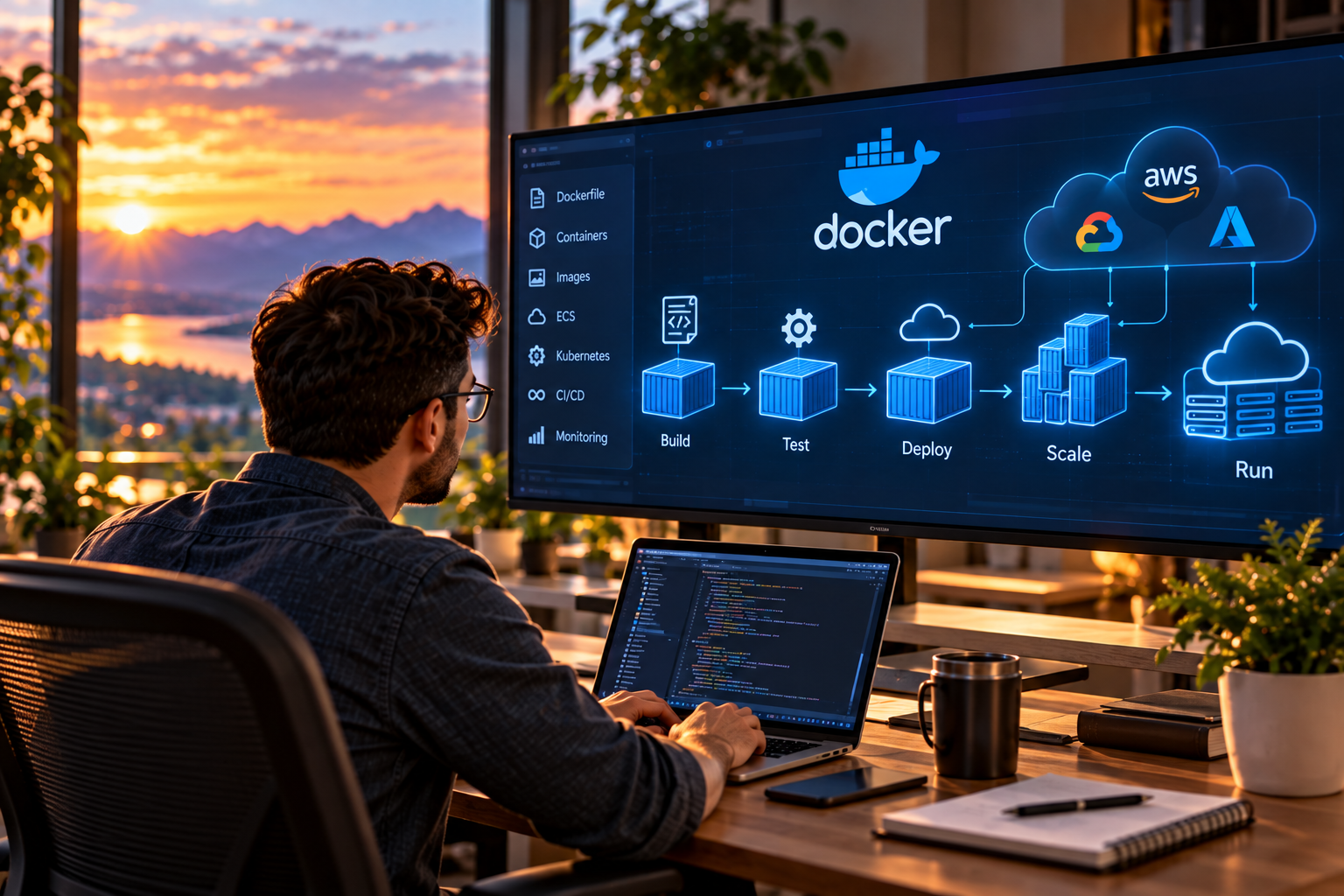
Docker Overview
Docker is a containerization platform that packages applications together with the software, libraries, and configuration they need to run. This creates consistent application environments that behave predictably as software moves from a developer’s computer into testing, cloud infrastructure, and production.
Without containerization, differences between environments can create deployment problems, configuration inconsistencies, and unnecessary complexity. Docker reduces those differences by creating standardized containers that can run across compatible infrastructure without rebuilding the application environment each time.
AspirationalX uses Docker to make application development and deployment more repeatable, portable, and scalable. Containers can simplify how applications are developed locally, tested, deployed through automated pipelines, operated in the cloud, and scaled as demand changes.
Our experience extends beyond creating individual containers. We use Docker as part of larger application and cloud architectures involving AWS ECS, microservices, CI/CD pipelines, APIs, databases, monitoring systems, and production environments designed for scalability and availability.
Docker is also valuable when modernizing existing applications. Workloads that were historically installed and configured directly on individual servers can often be containerized, creating clearer deployment processes and making applications easier to move, maintain, and operate.
The goal is not simply to put software inside containers. It is to create consistent, repeatable application environments that make software easier to build, safer to deploy, simpler to scale, and more reliable to operate.
Typical Use Cases for Docker
- Application containerization — Package applications and their dependencies into standardized environments that can run consistently across development, testing, and production.
- Consistent development environments — Give developers repeatable local environments that reduce configuration differences between individual machines.
- Cloud application deployment — Package workloads for deployment into AWS, other cloud platforms, or container orchestration environments.
- Microservices architecture — Separate larger applications into independently deployable services that can be developed, operated, and scaled individually.
- CI/CD and automated deployment — Build Docker containers into development pipelines so applications can be tested, packaged, and deployed through repeatable automated processes.
- Application modernization — Move applications away from manually configured servers toward more portable and maintainable container-based environments.
- Scalable application infrastructure — Run multiple container instances as demand changes rather than relying on a single application server.
- Testing and quality assurance — Create predictable environments for automated testing without requiring dedicated infrastructure for every test.
- Environment isolation — Keep applications and their dependencies separated to reduce conflicts between software running on the same infrastructure.
- Rapid deployment and recovery — Replace or redeploy standardized containers more predictably when applications need to be updated or infrastructure fails.
- Container orchestration — Use Docker with platforms such as AWS ECS or Kubernetes to manage deployment, scaling, networking, and availability across groups of containers.
- Legacy workload migration — Containerize suitable existing applications to make them easier to operate within modern cloud infrastructure.
Our Expertise with Docker
AspirationalX brings experience using Docker across software development, cloud infrastructure, application architecture, DevOps, and production operations.
We use Docker as part of the broader systems required to develop and operate modern applications. This includes containerizing application workloads, creating development environments, building container images, integrating containers into CI/CD pipelines, and deploying applications into cloud-based environments.
Our experience includes Docker workloads running within AWS ECS and other container orchestration architectures, as well as systems involving APIs, microservices, databases, caching layers, load balancing, monitoring, and automated infrastructure.
We have worked with containerized architectures supporting high-volume and performance-sensitive applications, where deployment consistency, horizontal scaling, resource management, availability, and operational visibility are critical parts of the system design.
Containerization also works closely with infrastructure automation. Docker can be combined with technologies such as Terraform and cloud-native services to create environments where both the application and the infrastructure supporting it can be deployed through repeatable processes rather than relying on manual configuration.
But adopting Docker does not automatically make an application scalable or reliable. Container design, networking, storage, security, orchestration, monitoring, resource allocation, deployment strategy, and the architecture of the application itself all influence how well a containerized system performs in production.
Our focus is therefore on using Docker where it makes the overall system more consistent, portable, maintainable, and operationally reliable, not simply containerizing applications for the sake of using containers.