
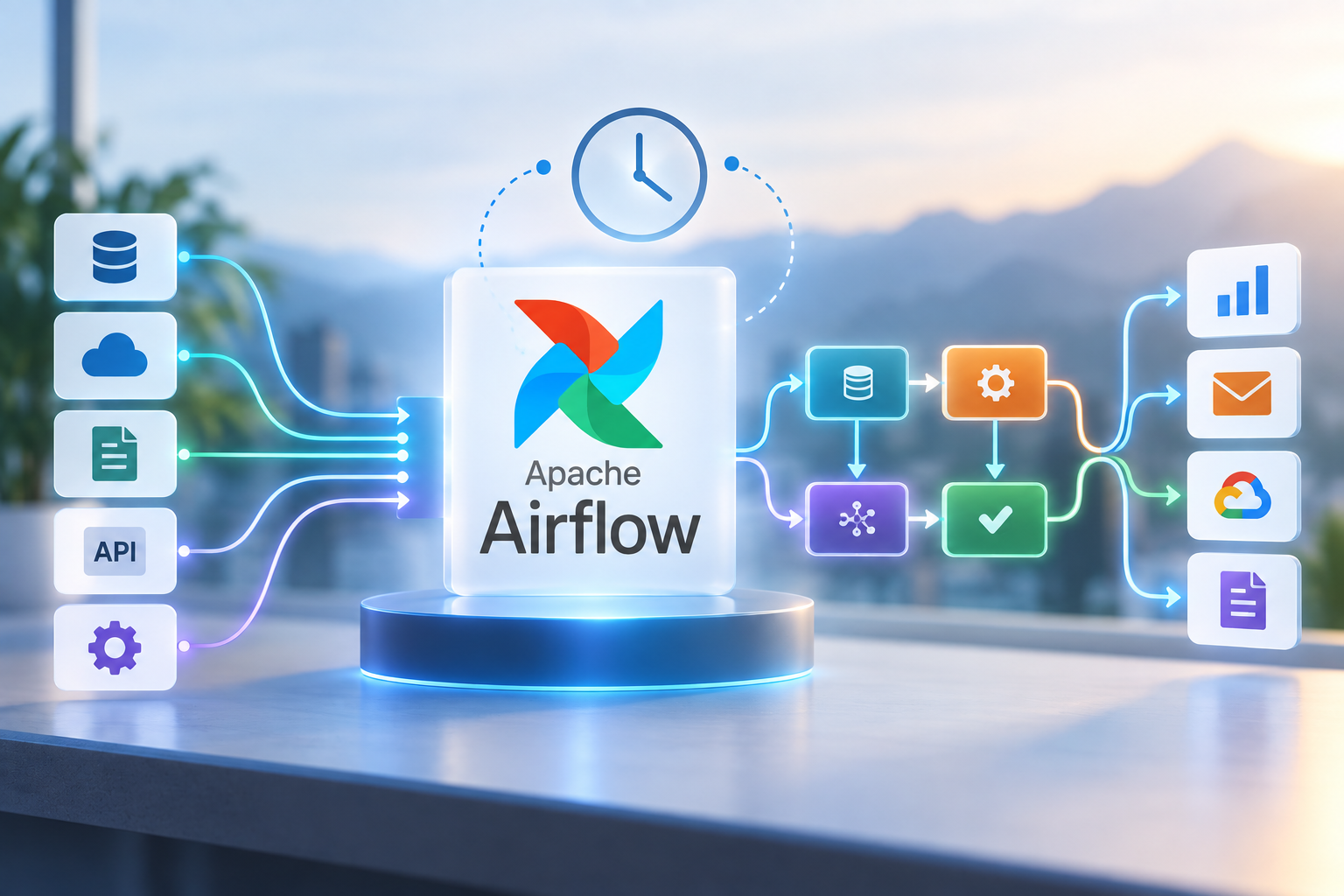
AspirationalX uses Apache Airflow to automate and orchestrate complex workflows, helping organizations move data reliably between systems, manage dependencies, reduce manual work, and keep critical processes running on schedule.
Apache Airflow Overview
Apache Airflow is an open-source workflow orchestration platform used to schedule, automate, coordinate, and monitor complex processes.
Instead of relying on people to manually start tasks, check whether previous steps completed, or move information between systems, Airflow allows those processes to be defined as repeatable workflows that run automatically.
Airflow is especially valuable for data pipelines and ETL processes, where information may need to move through multiple steps before it is ready to use. A workflow might collect data from several sources, validate it, transform it, load it into a data warehouse, trigger additional processing, and notify a team when everything is complete.
These workflows are organized as Directed Acyclic Graphs (DAGs), which define what tasks need to happen, when they should happen, and which steps depend on others.
For AspirationalX, Airflow is more than a scheduling tool. We use workflow orchestration to connect systems, automate repetitive processes, manage dependencies, improve reliability, and create greater visibility into how data moves throughout an organization.
The result is infrastructure that requires less manual intervention while making complex processes easier to operate, troubleshoot, and scale.
Typical Use Cases for Apache Airflow
- Data pipeline orchestration — Coordinate the movement and processing of data across databases, cloud storage, APIs, applications, and analytics platforms.
- ETL and ELT automation — Schedule and manage workflows that extract, transform, validate, and load information between systems.
- Scheduled processing — Automatically run hourly, daily, nightly, weekly, or event-driven jobs without requiring manual intervention.
- Workflow dependency management — Ensure tasks execute in the correct order and only continue when required upstream processes have completed successfully.
- Cloud data workflows — Coordinate processing across platforms and services such as AWS, Google Cloud, BigQuery, Databricks, and cloud storage.
- Data quality and validation — Add automated checks throughout pipelines to identify missing, incomplete, delayed, or unexpected data.
- Monitoring and failure recovery — Track workflow execution, identify failures, retry tasks, and alert teams when intervention is required.
- Large-scale data processing — Orchestrate distributed processing jobs involving large or complex datasets.
- API and system integrations — Automate workflows that exchange information between applications, databases, APIs, and third-party services.
- Reporting and analytics preparation — Ensure the data behind dashboards, reports, and analytic applications is refreshed and ready when users need it.
- Machine learning and AI pipelines — Coordinate the preparation, processing, and movement of data used by machine-learning and AI systems.
- Replacing manual processes — Turn repetitive technical or operational tasks into reliable, documented, automated workflows.
Our Expertise with Apache Airflow
AspirationalX has experience designing, building, maintaining, troubleshooting, and optimizing Apache Airflow workflows and production data pipelines.
Our work includes creating DAGs that coordinate complex ETL processes, managing dependencies between systems, integrating cloud services, processing large datasets, monitoring pipeline health, and improving workflows that have become difficult to maintain or scale.
We have worked with Airflow in environments involving Google Cloud Composer, BigQuery, Google Cloud Storage, Databricks, Apache Spark, APIs, databases, cloud infrastructure, and large-scale data warehouses.
That broader experience is important because Airflow rarely represents the entire solution. It sits at the center of a larger ecosystem, coordinating when and how different technologies work together.
AspirationalX approaches Airflow with that complete system in mind. We consider the source of the data, transformation requirements, dependencies, processing resources, failure scenarios, monitoring, documentation, downstream consumers, and the people who will ultimately maintain the workflow.
We also place a strong emphasis on making automation understandable and maintainable. Clear workflow structures, naming conventions, documentation, monitoring, and knowledge transfer help ensure organizations are not left with automation that only its original developer understands.
The goal is to create workflows that teams can trust. Automated when they should be, visible when something goes wrong, and structured to evolve as the organization grows.