
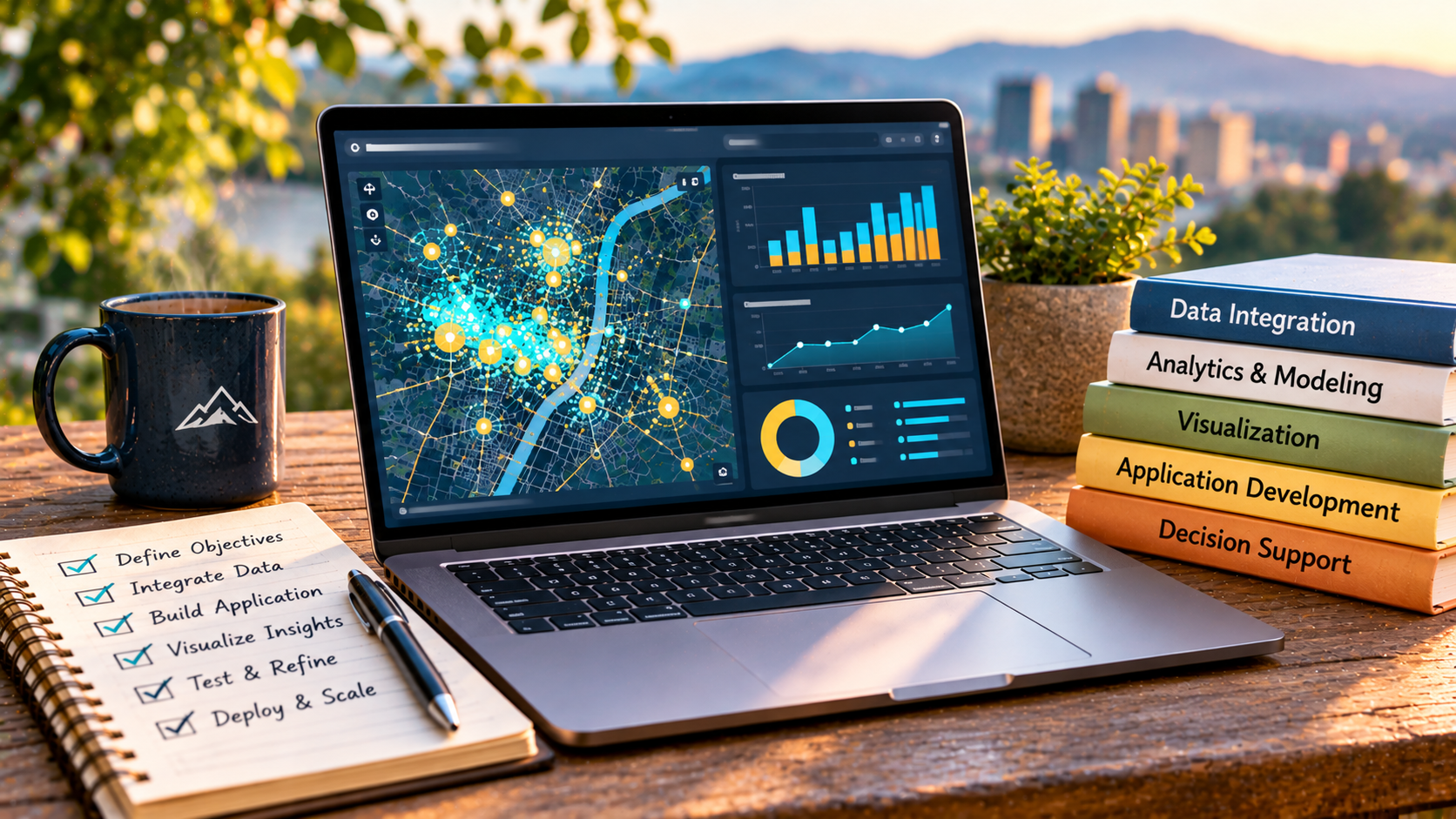
Analytics application design and development helps organizations turn complex data into interactive tools that support better decisions. By combining software engineering, data analysis, and intuitive visualizations, businesses can explore information, identify patterns, and apply meaningful insights to everyday operations.
Analytics Application Design and Development Overview
Analytics Application Design and Development is the process of creating software applications that allow organizations to collect, analyze, visualize, and interact with information. These applications combine data processing, analytical methods, software engineering, and user-focused design to help people understand complex information and use it to make informed decisions.
Organizations generate and collect significant amounts of information through business operations, customer interactions, financial systems, connected devices, and external data sources. While this information may contain valuable insights, it is not always easy to interpret or apply. Analytics applications provide a practical way to transform raw data into accessible tools that help users explore information, recognize patterns, and answer important questions.
Unlike static reports, analytics applications can provide interactive experiences that allow users to investigate information based on their specific needs. Features such as filtering, searching, geographic mapping, detailed comparisons, and interactive dashboards help users examine different aspects of a dataset. These capabilities make it possible to move beyond reviewing prepared results and explore information more independently.
Designing an effective analytics application begins with understanding its intended purpose. Organizations must identify the questions users need to answer, the information required, and how the resulting insights will influence decisions. Establishing these objectives helps determine which application features, analytical methods, and technical capabilities are necessary.
Data integration and processing form an important foundation. Applications may depend on information from databases, cloud platforms, business systems, external providers, or continuously generated data streams. This information often requires cleaning, transformation, and organization before it can support meaningful analysis. Reliable data pipelines and appropriate storage structures help ensure the application delivers information that users can trust.
Analytics applications may also incorporate more advanced analytical capabilities. Statistical methods, predictive models, machine learning algorithms, and scenario analysis can help organizations identify relationships or estimate potential outcomes. These features allow applications to provide insights that extend beyond displaying historical information.
User experience is equally important. Even sophisticated analytical technology may provide limited value if people cannot understand or navigate the application. Clear layouts, intuitive controls, useful visualizations, and understandable explanations help make complex analytical capabilities accessible to their intended audience.
Performance, security, and scalability must also be considered. Applications may process large datasets, support multiple users, or perform demanding calculations. Their architecture should account for processing requirements, response times, data access permissions, and infrastructure costs. Thoughtful planning helps organizations balance analytical functionality with dependable operation.
Testing and ongoing improvement are essential parts of development. Analytical results must be validated, application functionality must operate as expected, and users must be able to accomplish their intended tasks. Feedback, performance monitoring, and changing business requirements can guide refinements after an application is deployed.
AspirationalX approaches analytics application design and development by connecting data engineering, analytical methods, software architecture, and practical business objectives. We consider how information should move through a system, how analytical features should function, and how results can be presented in ways that help users make meaningful decisions.
The goal is to create reliable, intuitive, and adaptable analytical applications that turn complex information into useful tools for understanding business conditions, evaluating opportunities, and supporting informed action.
Typical Use Cases for Analytics Application Design and Development
- Custom Analytics Application Development — Design and build applications that allow organizations to explore, analyze, and interact with information tailored to specific business or operational requirements.
- Interactive Business Intelligence Applications — Develop analytical interfaces that combine dashboards, reporting, filtering, and detailed exploration to support performance monitoring and business decisions.
- Geospatial Analytics & Mapping Applications — Create interactive mapping tools that allow users to explore geographic information, identify spatial patterns, and evaluate location-based relationships.
- Predictive Analytics Application Development — Integrate statistical models and predictive algorithms into applications that help users evaluate potential future outcomes.
- Analytical Dashboard & Visualization Development — Build interactive charts, graphs, maps, and other visualizations that communicate complex information clearly and support meaningful exploration.
- Data Integration & Application Connectivity — Connect analytical applications with databases, APIs, data warehouses, external providers, and business systems to support reliable information exchange.
- Large-Scale Data Exploration Tools — Develop applications that allow users to search, filter, and analyze substantial datasets through efficient queries and responsive interfaces.
- Customer Behavior & Engagement Analytics Applications — Create tools for examining customer activity, engagement trends, purchasing patterns, retention, and other behavioral information.
- Operational Performance & Risk Analysis Tools — Develop applications that help organizations monitor operational conditions, evaluate performance, identify risks, and prioritize actions.
- Scenario Modeling & Decision Support Applications — Build interactive tools that allow users to compare assumptions, evaluate alternatives, and explore how changing conditions may affect outcomes.
- Analytics Application User Experience Design — Organize analytical features, navigation, visualizations, and interactions so users can understand complex information and accomplish tasks efficiently.
- Cloud-Based Analytics Application Architecture — Design scalable application environments that support data processing, storage, secure access, and analytical workloads using cloud infrastructure.
- Analytics Application Testing & Validation — Evaluate data accuracy, model outputs, application functionality, performance, and user experience to ensure dependable analytical results.
- Analytics Application Modernization & Enhancement — Improve existing applications by refining interfaces, integrating new data sources, expanding analytical capabilities, or addressing performance limitations.
Our Expertise with Analytics Application Design and Development
AspirationalX brings together software engineering, data science, data engineering, cloud computing, and analytical visualization experience to help organizations develop applications that make complex information accessible and useful. Our approach connects the technical requirements of processing and analyzing data with the practical needs of the people who rely on the resulting insights.
Our experience includes developing analytical applications that work with substantial volumes of geographic, behavioral, and operational information. These initiatives have involved connecting different data sources, processing complex datasets, and creating analytical functionality that helps users recognize patterns and understand relationships. This background provides perspective on the challenges of making demanding analytical systems both technically effective and useful to their intended audiences.
We recognize that analytics applications must be designed around the questions users need to answer. Different organizations may require tools for evaluating geographic patterns, monitoring operations, understanding customer behavior, or investigating complex datasets. We emphasize identifying these objectives before selecting technologies or defining application features so that development remains connected to meaningful outcomes.
Our broader data engineering experience provides a foundation for building the systems that support analytical applications. Data may need to be collected from multiple sources, transformed into consistent structures, and stored in environments suitable for efficient analysis. We consider how data pipelines, databases, warehouses, and processing technologies influence the reliability and responsiveness of the resulting application.
Our technical experience includes working with AWS, Google Cloud Platform, Apache Spark, Databricks, SQL, Python, and analytical visualization technologies such as Tableau. These tools can support different parts of an analytics application, from data processing and storage to analytical modeling and presentation. We evaluate their suitability based on application requirements, available information, performance expectations, and operational costs.
We also understand the importance of developing analytical functionality that can operate efficiently at scale. Applications working with large datasets or complex calculations may encounter processing delays, expensive queries, or infrastructure limitations. Our experience with distributed data systems and cloud architecture informs how we consider query performance, processing approaches, application responsiveness, and resource utilization.
Analytical applications frequently involve more than presenting prepared reports. Interactive filtering, geographic exploration, statistical analysis, and predictive capabilities can allow users to investigate information from different perspectives. We consider how these features can be incorporated into understandable interfaces that give users useful control without introducing unnecessary complexity.
Our experience with software architecture and application development supports the integration of analytical functionality with broader technical systems. Applications may rely on backend services, APIs, authentication mechanisms, databases, and supporting infrastructure. We evaluate how these components interact and how architectural decisions affect reliability, security, maintainability, and future development.
Collaboration between technical and business stakeholders is an important part of our approach. Data engineers, analysts, software developers, and end users may have different expectations about what an application should accomplish. We emphasize clear requirements, practical communication, and iterative feedback to ensure that analytical capabilities remain aligned with their intended purpose.
Our focus is on helping organizations develop dependable analytics applications that combine robust data processing, thoughtful software engineering, and understandable user experiences, making it easier to transform complex information into actionable insights and informed decisions.