
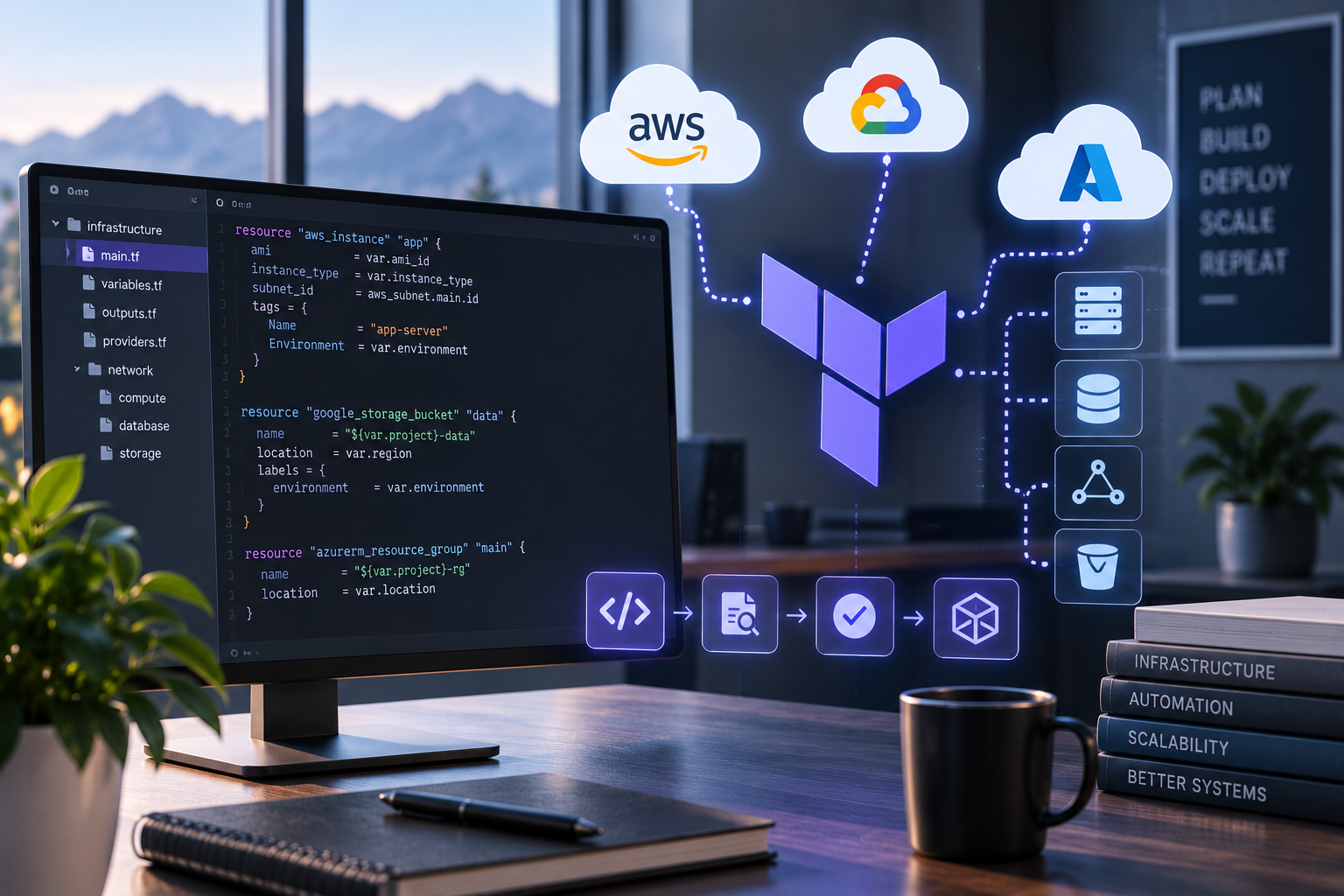
AspirationalX uses Terraform HCL to design, automate, and manage cloud infrastructure as code. Creating repeatable, scalable, and maintainable environments while reducing manual configuration, deployment risk, and infrastructure complexity.
Terraform HCL Overview
Terraform HashiCorp Configuration Language (HCL) enables organizations to define and manage cloud infrastructure as code (IaC).
Instead of manually configuring servers, networks, databases, security rules, and other cloud resources, infrastructure can be defined in code and managed through a consistent, repeatable process. Configurations can be reviewed, versioned, tested, deployed, and reused across environments.
For AspirationalX, Terraform HCL provides a structured approach to building and maintaining cloud infrastructure while making environments repeatable, visible, scalable, and easier to manage over time.
Typical Use Cases for Terraform HCL
- Infrastructure as Code implementation — Convert manually configured cloud infrastructure into documented, version-controlled Terraform configurations.
- Cloud environment deployment — Build repeatable development, staging, production, and other cloud environments.
- Infrastructure standardization — Create reusable modules and patterns that improve consistency across applications, teams, and environments.
- Cloud migrations and modernization — Use Terraform to support migrations, architecture changes, and modernization of existing infrastructure.
- AWS infrastructure automation — Provision and manage compute, networking, databases, storage, security, containers, and other AWS resources.
- DevOps and deployment automation — Integrate infrastructure changes into development and deployment workflows to reduce repetitive manual processes.
- Existing Terraform cleanup — Improve poorly structured configurations, modules, state management, documentation, and infrastructure that has become difficult to maintain.
- Configuration drift and environment consistency — Identify and reduce differences between intended infrastructure and what is actually deployed.
- Disaster recovery and reproducibility — Maintain infrastructure definitions that make critical environments easier to recreate and recover.
- Security, compliance, and FinOps — Apply consistent infrastructure controls while improving visibility into cloud resources, configurations, and costs.
Our Expertise with Terraform HCL
AspirationalX uses Terraform HCL to design, provision, modify, automate, and maintain cloud infrastructure across complex technology environments.
Our experience includes AWS infrastructure, networking, compute, databases, storage, security configurations, data platforms, containerized environments, and supporting cloud services. We use reusable Terraform modules and Infrastructure as Code practices to reduce manual work and establish consistency across environments.
Terraform also supports our broader work in cloud architecture, platform modernization, DevOps, data engineering, disaster recovery, security and compliance, FinOps, and large-scale infrastructure changes.
We can work with organizations at different stages of Infrastructure as Code adoption, from designing a new Terraform implementation to evaluating and improving an established environment. This includes addressing state management, configuration drift, module design, deployment risk, documentation gaps, maintainability, and infrastructure complexity.
Our focus is not simply writing Terraform configurations. We use Terraform as part of creating cloud environments that are understandable, reproducible, maintainable, and capable of evolving with the organization.