
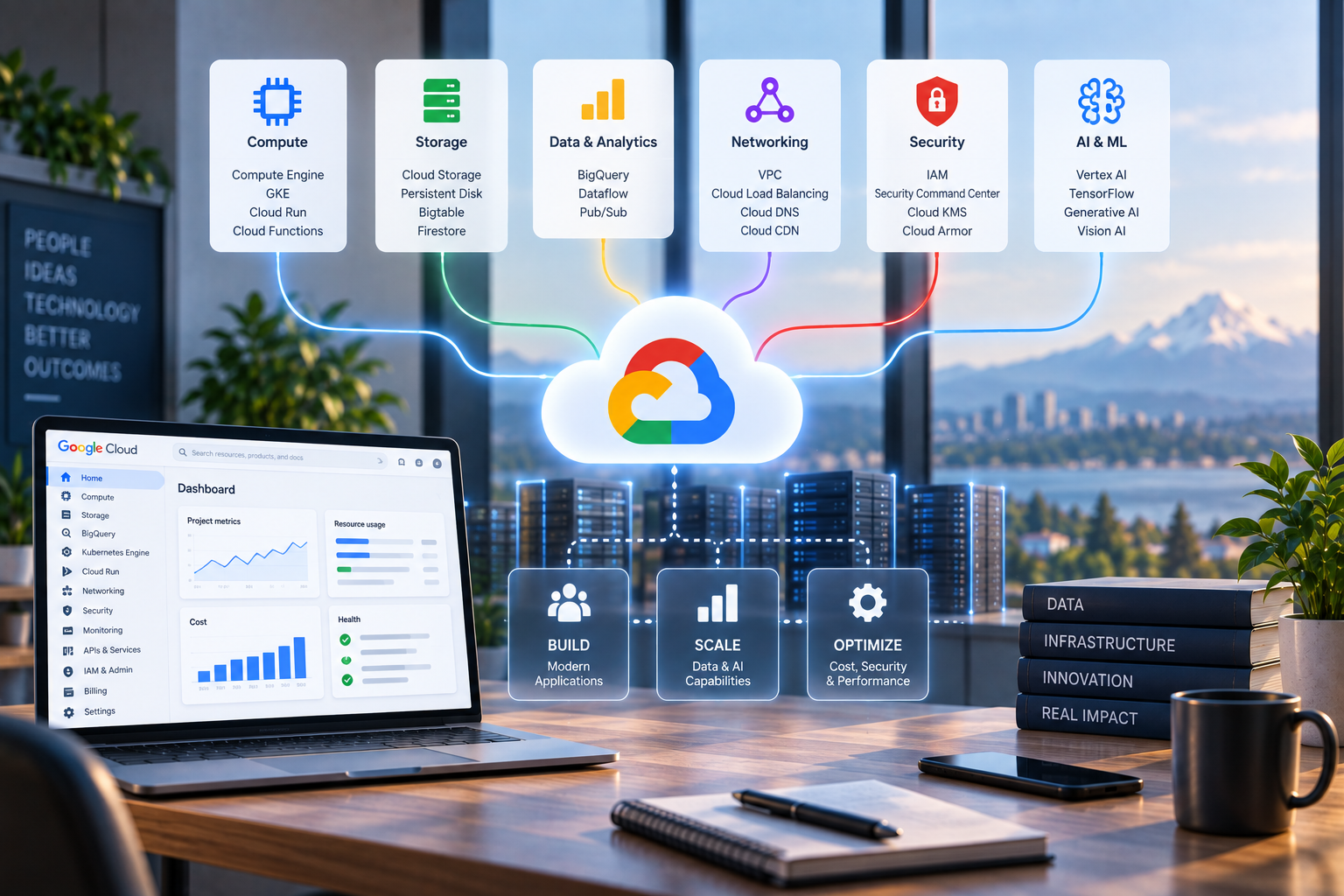
Google Cloud Platform (GCP) is Google’s suite of cloud services spanning compute, storage, data warehousing, and machine learning.
GCP Overview
GCP is Google’s cloud suite: compute (Compute Engine, GKE, Cloud Run, Cloud Functions), storage (Cloud Storage, Persistent Disk, Bigtable, Firestore), networking, and a data and machine-learning stack built around BigQuery, Dataflow, and Pub/Sub.
The service list is similar across major clouds, so it rarely determines the choice. In our experience, ventures choose GCP for one of three reasons:
BigQuery
Serverless analytics with no cluster to size or keep warm. For teams without a data-infrastructure group, that removes a category of operational work. Its consumption-based pricing makes query design a cost decision, not just a performance one.
Managed Kubernetes
GKE remains the least painful path for teams already committed to running containers at scale.
Gravity
The organization already uses Google’s identity and productivity stack, and keeping a single identity boundary is more valuable than a slightly better service elsewhere.
Where we spend most of our time is not the platform tour but the consequences: cost attribution, IAM boundaries that survive team growth, and making sure the team left running it understands why it was built this way. A cloud account nobody can explain is a liability regardless of which logo is on it.
Our Expertise with GCP
Our team holds Google Cloud certification. Michael Orlando has delivered on GCP where the reason to choose it was the data stack — BigQuery in particular — including geospatial analytics at hundred-terabyte scale and a point-in-polygon search rebuilt to a ten-thousandth of its previous cost.
That cost result both supports the platform and warns about it: BigQuery rewards users who understand its pricing and penalizes those who don’t.
Where we’ve applied it
- Developing an Advanced Analytics Application for a U.S. Government Client
- Scaling Smarter: Reducing Analytics Costs with a Query Viability Layer
- Six-Month Turnaround of Stalled Technical Projects
Typical Use Cases
- Application development and hosting
- Big data processing and analytics
- Machine learning and AI model deployment
- Hybrid and multi-cloud architectures
- Disaster recovery and business continuity