
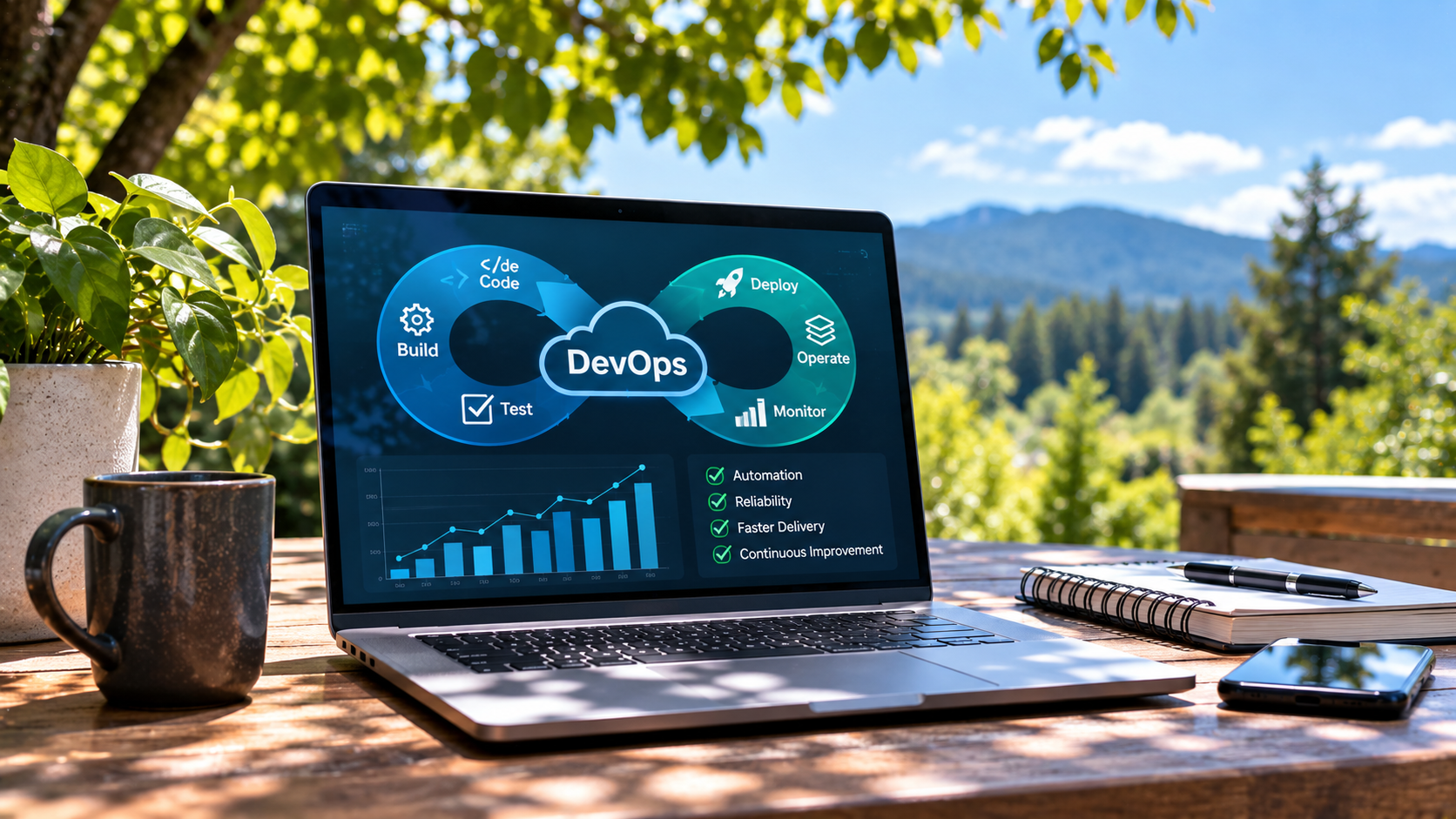
Make software releases more predictable and day-to-day operations easier to manage. We help you automate deployment, improve monitoring, and clarify responsibilities between the people building your software and those keeping it running.
DevOps Overview
DevOps is an approach to software development and technology operations that emphasizes collaboration, automation, and shared responsibility throughout the software lifecycle. It brings together the people who develop applications with those responsible for deploying, operating, and maintaining them. By connecting these responsibilities, organizations can improve how software is delivered, reduce unnecessary delays, and establish more dependable technology operations.
Traditional software development processes often separate development and operations into distinct teams with different priorities. Developers focus on creating functionality, while operations teams manage infrastructure, deployments, and system reliability. When these groups work independently, communication gaps, inconsistent environments, and unexpected technical challenges can slow progress. DevOps helps reduce these barriers by encouraging collaboration and shared understanding throughout the development process.
Automation is a central component of DevOps. Activities such as building applications, running tests, preparing infrastructure, deploying software, and monitoring systems can involve repetitive manual steps. Automating appropriate portions of these processes improves consistency, reduces opportunities for human error, and allows teams to spend more time addressing meaningful technical and business challenges.
Continuous Integration and Continuous Delivery (CI/CD) are important practices within DevOps. Continuous integration helps developers regularly combine and validate code changes through automated processes. Continuous delivery establishes repeatable methods for preparing software updates for release, while continuous deployment can automatically release changes that meet established requirements. These practices support smaller, more manageable updates and help teams identify issues earlier.
Infrastructure as Code (IaC) provides another important foundation. Rather than relying entirely on manual infrastructure configuration, organizations can define computing resources, networking, storage, and supporting services through configuration files and automated processes. This approach makes environments easier to reproduce, review, maintain, and adjust as application requirements change.
Monitoring and operational visibility are also essential. Applications and infrastructure may encounter performance limitations, unexpected errors, resource constraints, or availability issues. Monitoring tools and feedback processes help teams recognize these conditions, understand their causes, and respond before they create larger disruptions. Reliable operational information also supports decisions about future improvements.
DevOps encourages shared accountability for software quality, security, and reliability. Development teams benefit from understanding how their applications behave in production, while operations teams contribute knowledge about infrastructure, performance, deployment requirements, and operational risks. Collaboration across these areas helps organizations make technical decisions that consider the entire lifecycle of a system.
Cloud computing has expanded the capabilities available to DevOps teams. Platforms such as Amazon Web Services (AWS), Google Cloud Platform (GCP), and Microsoft Azure provide services for infrastructure automation, application deployment, monitoring, and resource management. These technologies can support flexible development environments and scalable operational practices when configured and managed appropriately.
AspirationalX approaches DevOps by connecting software engineering, cloud infrastructure, automation, and practical team coordination. We help organizations evaluate development and deployment processes, identify opportunities to improve consistency, and establish approaches that support reliable software delivery and maintainable operations.
The goal is to create development and operational practices that help teams collaborate effectively, deliver improvements with less friction, and maintain dependable systems as applications and business requirements evolve.
Typical Use Cases for DevOps
- Continuous Integration & Continuous Delivery (CI/CD) — Establish automated processes for building, testing, validating, and preparing software changes for deployment.
- Automated Software Deployment — Develop repeatable deployment workflows that reduce manual intervention, improve consistency, and support reliable application releases.
- Infrastructure as Code (IaC) — Define and manage infrastructure through configuration files and automation tools to support consistent environments and controlled infrastructure changes.
- Cloud Infrastructure Automation — Automate the provisioning, configuration, and management of cloud resources used by applications and supporting services.
- Development, Testing & Production Environment Management — Establish consistent environments that support software development, validation, deployment, and ongoing operations.
- Containerization & Container Orchestration — Use technologies such as Docker, Kubernetes, and managed container services to package, deploy, and operate applications across environments.
- Application Monitoring & Observability — Implement monitoring, logging, metrics, and alerting practices that provide visibility into application behavior and infrastructure performance.
- Release Management & Deployment Coordination — Establish practices for organizing software releases, managing dependencies, coordinating updates, and reducing deployment-related disruptions.
- Automated Testing & Quality Validation — Integrate testing and validation into development workflows to identify defects and compatibility issues before software reaches production.
- System Reliability & Incident Response — Develop operational practices for recognizing system problems, investigating failures, restoring services, and improving resilience.
- DevOps Security & Access Controls — Incorporate security checks, secrets management, permissions, and appropriate safeguards into infrastructure and deployment processes.
- Version Control & Collaborative Development — Establish source code management practices that support code review, change tracking, shared development, and coordinated releases.
- DevOps Workflow & Process Improvement — Evaluate existing development and operational practices to identify bottlenecks, unnecessary manual work, and opportunities for greater efficiency.
- Scalable Application Operations — Design deployment and infrastructure processes that support changing workloads, application growth, and evolving technical requirements.
Our Expertise with DevOps
AspirationalX brings together software engineering, cloud computing, infrastructure automation, system architecture, and technical operations experience to help organizations establish effective DevOps practices. Our approach emphasizes practical automation, reliable deployments, and clear coordination between the people responsible for developing and operating software systems.
Our experience with Amazon Web Services provides a foundation for supporting cloud-based development and operational environments. Applications may depend on computing resources, container services, databases, networking, load balancing, and security configurations that must work together reliably. We consider these dependencies when helping organizations design and improve infrastructure and deployment workflows.
Infrastructure automation is an important part of our technical capabilities. We work with tools such as Terraform to define infrastructure through repeatable, version-controlled configurations. This approach supports more consistent environments, improves visibility into infrastructure changes, and reduces the reliance on manual configuration processes that can become difficult to maintain as systems grow.
Our experience also includes containerized applications and the infrastructure used to deploy them. Technologies such as Docker, AWS Elastic Container Service (ECS), and related cloud services provide approaches for packaging applications, managing deployments, and supporting operational scalability. We consider how container configurations, infrastructure requirements, and deployment processes interact to support dependable application operations.
We recognize that software deployment should be a controlled and understandable process. Changes to application code, configurations, infrastructure, and dependencies can affect multiple parts of a system. Our approach emphasizes establishing repeatable workflows, identifying important validation steps, and creating clear procedures for introducing updates while reducing unnecessary operational risk.
Monitoring and operational awareness are also important considerations. Applications require ongoing attention to availability, performance, errors, and resource consumption. We help organizations consider how logs, metrics, alerts, and monitoring systems can support troubleshooting, improve visibility, and provide useful information for operational decisions.
Our broader experience with high-volume data systems, cloud infrastructure, and software architecture informs how we approach performance and reliability. Applications may need to manage demanding workloads, changing traffic patterns, or dependencies across multiple services. We consider these operational realities when evaluating infrastructure configurations, deployment methods, and opportunities for automation.
DevOps also requires effective communication and collaboration. Technical tools alone cannot resolve unclear responsibilities, inconsistent development practices, or gaps between engineering and operations teams. Our project management and engineering management experience provides perspective on establishing shared expectations, documenting important decisions, and coordinating work across different contributors.
We understand that DevOps practices should reflect an organization’s actual needs and resources. Smaller teams may benefit from straightforward automation and simplified infrastructure, while larger environments may require additional controls, monitoring, and deployment coordination. We emphasize selecting approaches that provide meaningful operational value without introducing unnecessary complexity.
Our focus is on helping organizations connect software development with dependable operations through practical automation, collaborative workflows, and maintainable infrastructure that supports continued improvement and business growth.